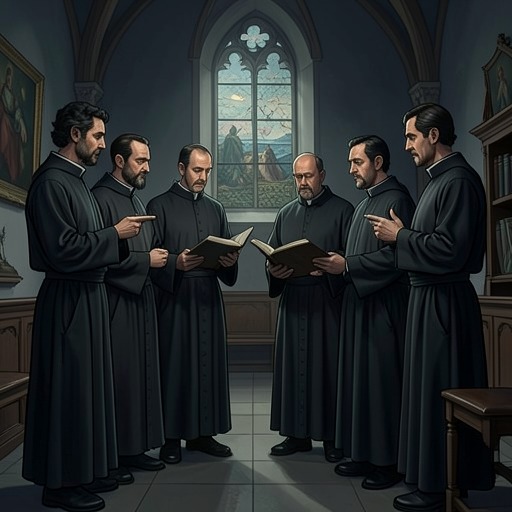
Church decree reclassifying the sea folk from demons as beasts
The Moon and the SunThe Church decree reclassifying the Sea People from demons as beasts is a revealing act of institutional classification: it withdraws one religious label without granting the Sea People the standing of persons. The change becomes central when Marie-Josèphe argues that the sea woman speaks and thinks, while Louis XIV, Yves, Lucien, and Pope Innocent debate what evidence could alter her status. At the novel’s close, the decree is no longer presented as a settled answer but as part of a history the Church must correct—and then conceal.
From Demons to Beasts
The decree is identified as the Church’s act of raising the Sea People from demons to beasts. That change implies a real shift in classification, but not a passage into human standing: the sea woman remains a captive being whose intelligence and speech are disputed, and whose treatment is still vulnerable to decisions made by powerful human authorities. Pope Innocent recalls the earlier position by insisting that the beings once regarded as beasts were products of demonic possession and that the Inquisition had driven out satanic influence. His defense makes clear that the categories were not merely descriptive. The Church’s interpretation had authorized coercive intervention against the Sea People as supposed instruments of demonic power.
The change from demon to beast therefore offers neither a vindication of the Sea People nor protection from human exploitation. Yves later names the consequences bluntly: they have been tormented as demons and preyed upon as cattle. He says they are nearly extinct because of the Church. The paired descriptions expose the material continuity beneath the change in doctrine: even when the Church’s explanation shifts, the Sea People remain available to be subjected to violence and treated as less than human.
The Sea Woman as a Test of Classification
Marie-Josèphe contests the language of monstrosity through her encounter with the sea woman. She tells Louis XIV that she understands the woman and that the woman understands her; the sea woman speaks, is intelligent, and is human. When the woman surfaces, coughs out water, and gasps for breath, her swollen features strike the onlookers as grotesque. Louis asks what she is if not a monster. The difference between Marie-Josèphe’s claim and the court’s reaction is not a lack of visible evidence that the creature lives, but a struggle over what that life means.
Yves dismisses the sea woman’s intelligence by comparing it to a parrot’s. Louis, too, turns the question of understanding into a joke about whether his cat should be given a place at court. Such comparisons reduce communication to a test that can be waved away rather than a reason to reconsider the category. Marie-Josèphe’s claim that the sea woman is a woman and human directly challenges the old division between human beings and creatures; the decree’s demotion from demon to beast leaves that challenge unresolved.
Proof, Authority, and the Possibility of Reclassification
Lucien argues that the Church’s own history shows that a being’s status can change. He reminds the King that the Church once mistook beasts for demons, then points to the reclassification as evidence that another change is possible. He frames the remaining question as one of proof: whether the sea woman speaks a human language and is therefore not a creature. Rather than asking the court to accept Marie-Josèphe’s judgment on trust, he urges Louis to let her demonstrate her contention.
The appeal to proof does not settle the dispute. Pope Innocent asks whether Marie-Josèphe has discussed souls or Christian faith with the sea woman, or converted her. When she answers that she has done none of those things, he challenges the basis for believing the Church wrong. The exchange shows the conflict between observable communication and a religious test that makes spiritual knowledge and conversion the measure of standing. Meanwhile, Louis’s readiness to consider Marie-Josèphe’s evidence gives the debate political consequence: classification is not simply an abstract theological question, but one that depends on who is permitted to define and interpret the Sea Woman’s capacities.
Correction and Erasure
At the final confrontation, Pope Innocent accepts the claim that the Sea People are people, surprising both Marie-Josèphe and Yves. Yves connects that admission to the Church’s history of persecution: instead of offering the Sea People Christianity, the Church tormented them as demons and exploited them as cattle. Innocent answers that history must be corrected. The decree that raised the Sea People from demons to beasts is then named among the records and representations to be swept away.
The order reaches beyond a change of doctrine. Innocent produces Marie-Josèphe’s dissection sketches, burns one in a candle flame, and drops the ashes into a golden Aztec dish. He also demands the destruction of paintings, myths, memories, and the Church decree itself, directing Yves to erase the sea monsters’ existence from the conscience of the present and the memory of posterity. The decree is thus caught in a double movement: it records an earlier reclassification, but becomes something the Church now wants removed as it attempts to rewrite the account of its own conduct. Acknowledging the Sea People as people does not, by itself, restore what persecution has taken from them; the command to erase their history makes that recognition inseparable from a new struggle over who will control their memory.